
Social Media Marketing for Law Firms
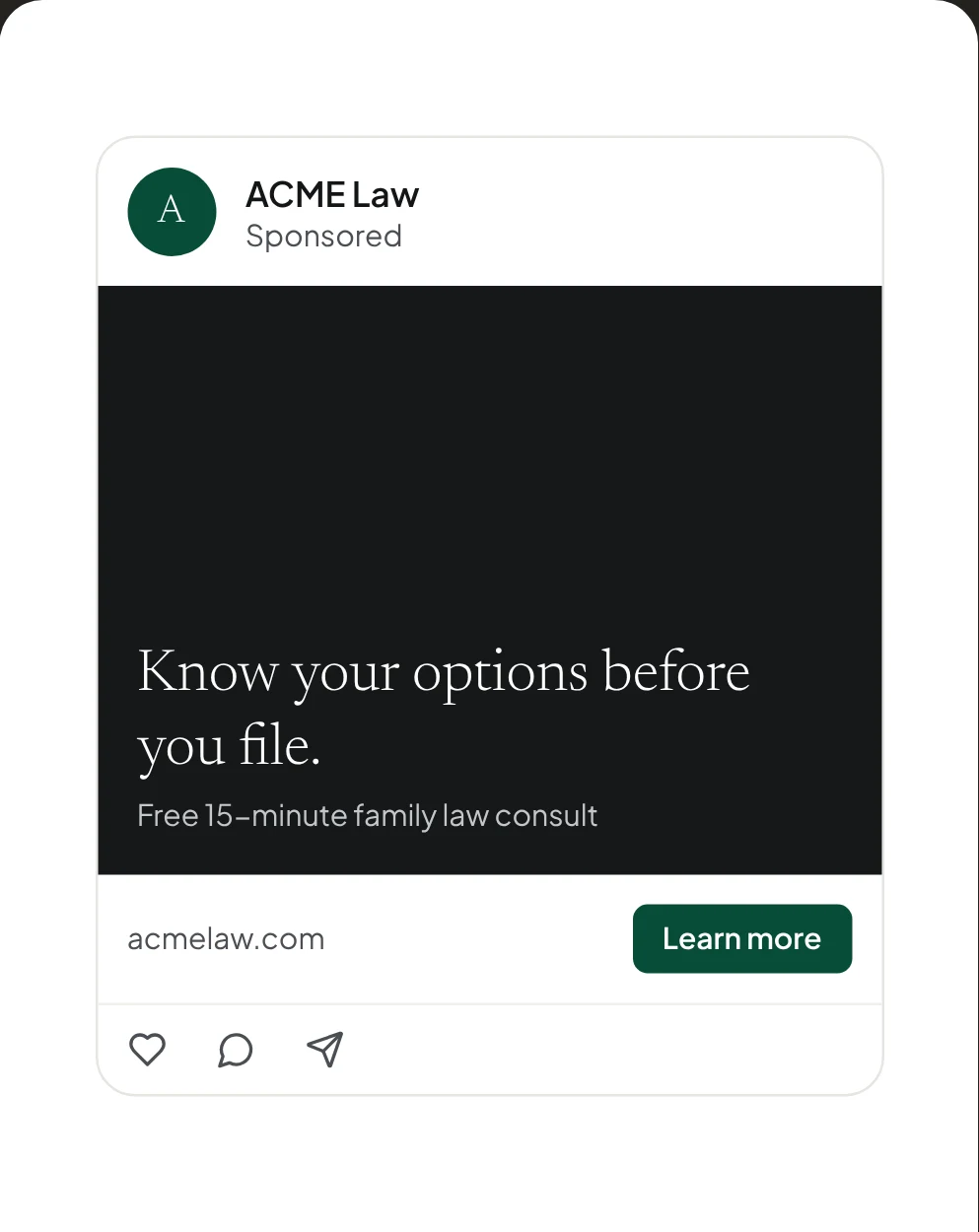
Lotus Signal runs social media marketing for law firms: Facebook and Instagram ads targeted by location and interest, retargeting for people who visited the firm's site and didn't call, multilingual ads where the audience calls for it, and organic posts built around video. It is one part of the marketing Lotus Signal runs for established firms, for one flat monthly fee. Your ad spend is paid directly to Meta from your own account, with no markup.
Where this fits
Social media is one lever inside Execution. It rarely works alone; in Strategy we decide whether it should find new clients, stay in front of people who already searched, or both.
See everything the engagement coversWhat does social media do for a law firm?
Social media builds a firm's brand and educates its audience. It works on brand recall: when someone in that audience needs an attorney, they think of the firm they have been seeing. It can send people to a landing page on the firm's website, but it doesn't need to: it can stay on social and still do its job. For most practice areas it is a support channel rather than the one that signs the case.
Paid and organic social do different jobs. Paid social puts the firm in front of the right people in its area and brings back the ones who visited and didn't call. Organic social is for trust and brand awareness: regular posts, mostly video, that show who the firm is.
How does Lotus Signal run social media for a law firm?
The work runs in six steps. The first four are paid social; the last two are organic.
1. Target by location and interest
Paid social starts with location and interests, so the ads are hyper-personalized to the people the firm actually serves.
How this works
Location and interests are the place to start. Targeting the area the firm serves and the interests of the people it helps keeps the ads hyper-personalized, instead of spread across everyone on Facebook and Instagram.
Ads aimed at the public like this are generally not solicitation: the comments to ABA Model Rule 7.3 say communications directed to the general public, such as internet banner ads and websites, typically aren't (ABA, 2026). Each state adopts its own version.
2. Retarget people who are still researching
Retargeting brings back people who visited the firm's site and didn't call, which helps convert potential clients in the research phase.
How this works
Retargeting helps convert potential clients who are in the research phase: people who have already visited the firm's site but haven't called yet. Meta builds these website custom audiences from people who visited or took an action on the site through the Meta Pixel, for a window the advertiser sets (Meta, 2026).
3. Run ads in the languages your clients speak
Multilingual ads reach people in the language they use, wherever the firm's audience calls for it.
How this works
Where the firm's audience speaks more than one language, the ads do too. Reaching people in the language they use matters most in practice areas like immigration, where decisions are often talked through with family before anyone searches.
4. Let it work on the platform
Social doesn't need to send people anywhere; it can stay on social and still do its job of keeping the firm top of mind.
How this works
Paid social can send people to a landing page on the firm's website, but it doesn't need to get anywhere. It can stay on social and still do its job: brand recall, so the firm is the one people think of when they need an attorney.
5. Post at least three times a week, mostly video
Organic social means posting at least three times a week, with a focus on video, for trust and brand awareness.
How this works
Firms should post at least three times a week, with a focus on video. The point is trust and brand awareness: letting people see who the attorneys are and how the firm thinks before they ever need to call.
Posts about cases need care. ABA Formal Opinion 480 says lawyers who blog or comment publicly can't reveal information about a representation without the client's informed consent, even when it is in a public record (ABA, 2018).
6. Post to a plan, not at random
The most common mistake firms make is posting randomly, so every post follows a plan tied to the firm's brand and practice areas.
How this works
The most common mistake firms make is posting randomly. Posts follow a plan tied to the firm's brand and its practice areas, so each one adds to the same picture of the firm.
What do paid and organic social each do for a law firm?
Paid and organic social do different jobs. Paid reaches the right people and brings back the ones still researching; organic builds trust and keeps the firm in mind.
| Part of the work | What it's for |
|---|---|
| Ads targeted by location and interest | Reach |
| Retargeting site visitors who didn't call | Conversion |
| Ads in the languages your clients speak | Reach |
| Ads and posts that stay on social, no click needed | Recall |
| Organic posts, at least 3 a week, mostly video | Trust, recall |
Where social fits next to the other channels differs by practice area. The practice pages for immigration, family and divorce, criminal defense, estate and probate and personal injury show the channel mix for each.
How much should a law firm spend on Facebook ads?
At least $3,000 a month for Facebook and Instagram ads. The ad spend is paid to Meta from the firm's own account; Lotus Signal's flat monthly fee is separate.
When does social media make sense for a law firm, and when doesn't it?
Social builds recall over time. It works best next to the channels that catch people who are searching right now.
Social fits when…
The firm wants to be the name people remember when they need an attorney, and can post at least three times a week.
Paid social has at least $3,000 a month, and there is site traffic worth bringing back.
Something else comes first when…
The firm needs calls in the next few weeks. Google Search Ads and Local Services Ads can start bringing in calls within the first several weeks after launch.
There is no plan for the posts. Posting randomly is the most common mistake, and it wastes the work.
In Strategy, Lotus Signal decides whether social should find new clients, stay in front of people who already searched, or both.
What does this look like for a real firm?
Here is how the work plays out, without a client's numbers attached. A firm runs Facebook and Instagram ads targeted by its location and the interests of the people it serves, in the languages they speak, and retargets people who visited its site but didn't call. It posts at least three times a week, mostly video, to a plan. Most people who see it don't need a lawyer that day. When one of them does, the firm is the one they remember.
Social runs inside the wider marketing Lotus Signal runs for a firm. The proof from that wider work, across every channel and not social alone:
Law Office of Phan Nguyen · Texas · Immigration & Family Law: 15× increase in qualified monthly leads (5 → 75) · 4× lower customer acquisition cost.
Want to know where social could fit for your firm? Get a free marketing audit of your website, Google presence and reviews, or book a call to talk it through.
Frequently asked questions
Yes, as a brand and education channel. It builds brand recall, so when people need an attorney they think of the firm. For most practice areas it supports the channels that bring in calls rather than signing cases by itself.
At least $3,000 a month for Facebook and Instagram ads, paid to Meta from the firm's own account.
At least three times a week, with a focus on video, and to a plan. Posting randomly is the most common mistake.
Mostly video that builds trust and brand awareness: who the attorneys are and how the firm thinks. Posts about specific cases need the client's informed consent, even when the information is in a public record.
Start with location and interests, so the ads are hyper-personalized to the area the firm serves and the people it helps. Retargeting then brings back people who visited the firm's site and didn't call.
Showing ads to people who have already visited the firm's website but haven't called. It helps convert potential clients who are still in the research phase.
Generally, yes. The comments to ABA Model Rule 7.3 say communications directed to the general public, such as internet banner ads and websites, typically aren't solicitation. Each state adopts its own version, so check your state's rules.
Where the firm's audience speaks more than one language, yes. It matters most in practice areas like immigration, where decisions are often talked through with family before anyone searches.
Start with a conversation
A short call to see if this is the right fit.
Not a pitch. Not a demo. A conversation about your firm, where the cases are coming from, and whether there's a real opportunity to build something better. Fit matters more than volume.
A short, focused conversation. No pitch deck. No annual commitment.
Prefer to start in writing? Get a free marketing audit by email.