
SEO and AI Search for Law Firms
Lotus Signal runs SEO for law firms: local SEO and the Google Business Profile, content that answers your clients' questions, the technical basics, and the work that gets a firm cited when people ask ChatGPT, Gemini or Google's AI Overviews for a lawyer. It is one part of the marketing Lotus Signal runs for established firms, for one flat monthly fee.
Where this fits
SEO and AI search are one lever inside Execution. They build slowly, so in Strategy we decide how much to invest in them against the faster channels.
See everything the engagement coversWhat is SEO for law firms, and what is AI search?
SEO for law firms is the work of getting a firm found when people look for a lawyer: in Google's map results, in the regular results below them, and in the answers AI tools now give. For most firms it starts with local search. Google ranks local results on three things: relevance, distance and prominence. A firm can't change how far it is from the person searching, so the work goes into the other two.
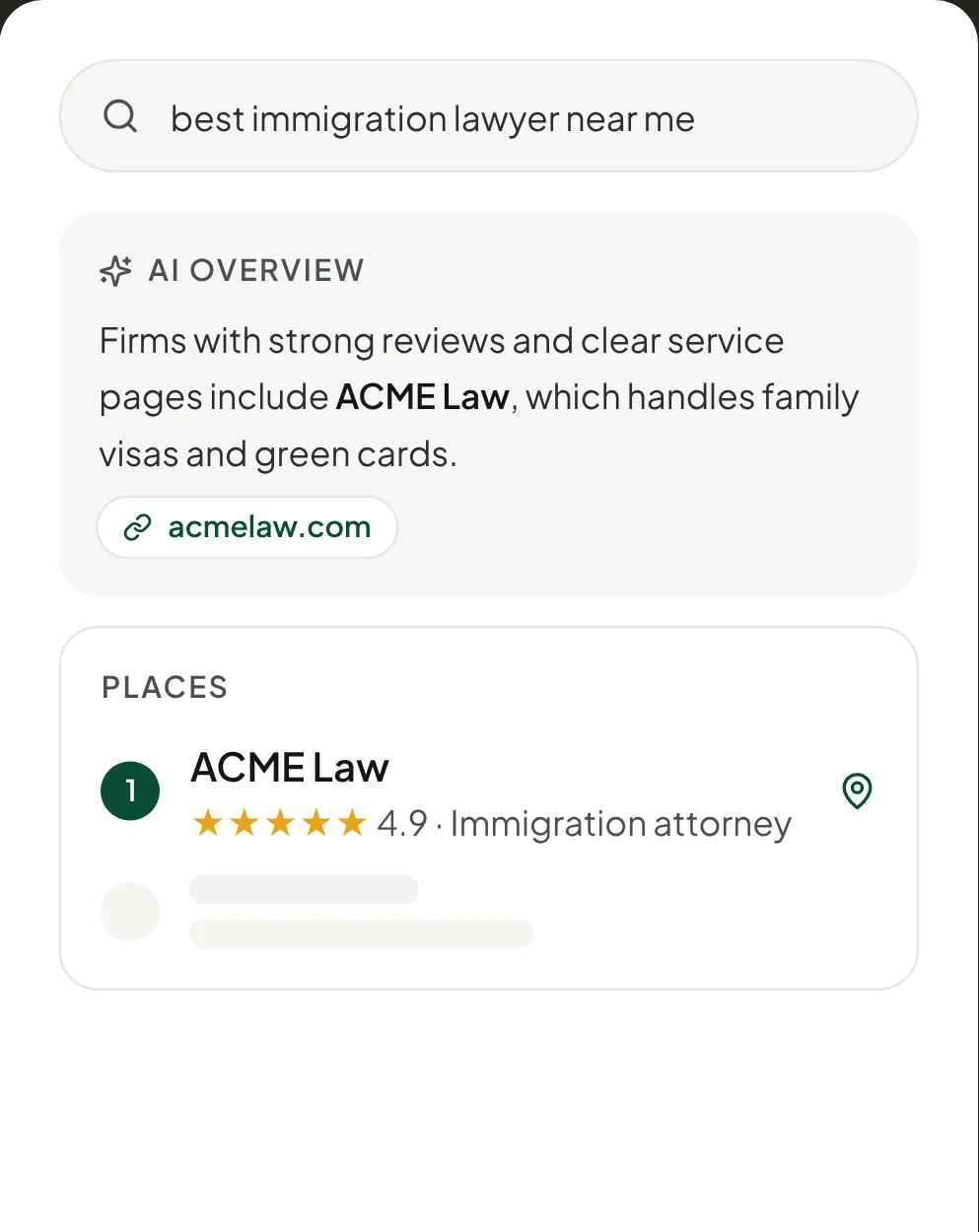
AI search is the newer part. People ask ChatGPT, Gemini or Google's AI Overviews what their options are or which lawyer to call, and get one written answer with a few sources instead of a list of links. Google says its AI features have no additional technical requirements: a page has to be indexed and eligible to show in Search with a snippet. So the foundation is the same SEO work. What AI search adds is a stronger need for the firm to be easy to recognize and quote: reviews, consistent listings, mentions on other sites and content that answers the question first.
How does Lotus Signal run SEO and AI search for a law firm?
The work runs in five steps. The first four build the foundation and keep it current; the fifth repeats every month.
1. Complete the Google Business Profile, then keep it current
The profile has to be complete and accurate, and it has to stay that way, because the mistake firms make most is not updating it.
How this works
Google's own advice for local ranking starts with complete and detailed business information. The first pass makes sure every field is filled in and correct: name, address, phone number, hours, categories, services and the website link.
The mistake found most often isn't a missing field on day one. It is a profile that was set up once and then left alone, so the information drifts out of date. The profile gets updated on an ongoing basis, not once.
2. Fix the structure and depth of the website
The first technical check is the site's structure and depth: a clear page for each practice area, with enough on it to show what the firm handles.
How this works
The first technical check on a law firm site is its structure and depth: whether each practice area has its own page, whether those pages link together in a way that makes sense, and whether each one says enough to show what the firm actually handles. A single page that lists every practice area gives Google little to rank. Law firm website design covers fixing that structure or rebuilding it.
The rest of the technical basics follow: pages Google can crawl and index, a site that loads quickly and works on a phone, and structured data that describes the firm and its pages. Google describes structured data as explicit clues about the meaning of a page, and it should only describe what visitors can see.
3. Choose content from who your clients are
Topics come from the firm's target audience, their demographics and their interests, and quality beats volume every time.
How this works
Every topic starts with the people the firm wants to reach: who they are, their demographics and their interests, and the questions they have when they first look for a lawyer. The content answers those questions.
Volume isn't the goal. A high blog count is worth nothing if the content is mediocre. What counts is quality, timeliness and the experience, expertise, authoritativeness and trust that Google calls E-E-A-T.
4. Have an attorney review the content
An attorney at the firm always reviews the content, at least in the beginning, to capture the firm's voice and tone.
How this works
Each piece is reviewed by an attorney at the firm, at least in the beginning, to capture the firm's voice and tone. The content has to read like the firm wrote it, because to a potential client it is the firm talking.
5. Optimize and scale what works
Quick wins show in the first three to six months with the right strategy; after that, the work is optimizing what's working and scaling it.
How this works
With the right strategy, firms start to see quick wins in the first three to six months, and that doesn't differ by practice area. Each month after that, the pages, topics and listings that bring in calls get improved and built on, and the ones that don't get fixed or cut.
What does each part of SEO and AI search work improve?
Each part of the work feeds a different place a firm can be found. With the right strategy, quick wins show in the first three to six months; after that, each part is optimized and scaled.
| Part of the work | What it improves |
|---|---|
| Google Business Profile, complete and kept current | Map results |
| Website structure and depth, one page per practice area | Rankings |
| Technical basics: crawling, speed, mobile, structured data | Rankings, AI |
| Content chosen from your clients' questions, reviewed by an attorney | Rankings, AI |
| Reviews, consistent listings and mentions on other sites | Map results, AI |
| Monthly AI visibility and referral tracking | Decisions |
How much of the budget goes into SEO next to the other channels differs by practice area. The practice pages for immigration, family and divorce, criminal defense, estate and probate and personal injury show the channel mix for each.
How does a law firm get recommended by ChatGPT, Gemini and AI Overviews?
A law firm gets recommended by AI tools by being easy to find, easy to verify and clearly the right fit for the question. In Lotus Signal's work, four things matter most: reviews, the firm's social media presence, structured content and data, and its brand. Law firm branding covers how a firm builds one, and social media for law firms covers the social side.
In practice that comes down to five pieces of work: a steady flow of reviews; the same name, address and phone number on every listing; mentions of the firm on other sites; pages that answer the question in their first sentence; and structured data that describes the firm and matches what the page shows.
None of it needs a separate technical setup. Google says there is no special schema to add for its AI features, and that AI Overviews only show when they add something to the regular results, so they often don't appear. What does matter is access. ChatGPT search relies on OpenAI's OAI-SearchBot crawler, and sites that block it aren't shown in ChatGPT search answers (OpenAI, 2026).
For more on what AI search changes and what it doesn't, read AI search and law firm marketing.
How is AI search visibility tested each month?
Every month, Lotus Signal uses its own tools to measure how visible the firm is in AI search, and tracks the traffic and referrals that reach the firm's website from AI tools. Both go into the monthly review next to calls and signed cases, so the firm can see whether AI search is sending people, not just mentioning its name.
When is SEO the right lever, and when do faster channels come first?
SEO builds slowly and keeps working once it is built. Google Search Ads and Local Services Ads can start bringing in calls within the first several weeks after launch.
SEO and AI search fit when…
The firm plans to be in its market for years and wants something it owns: a website, a content library, a review base and a ranking footprint that keep working whatever it decides about marketing later.
Quick wins in three to six months, followed by steady optimizing, fits the firm's plans.
Faster channels come first when…
The firm needs calls in the next few weeks. Local Services Ads and Google Search Ads can start bringing in calls within the first several weeks; organic search builds over a longer period.
The website isn't ready to turn visitors into calls. More traffic to a site that leaks leads wastes the work, so the site gets fixed first.
Most firms run both. In Strategy, Lotus Signal decides how much goes into SEO against the faster channels, and the monthly review checks that split.
What does this look like for a real firm?
For the Law Office of Phan Nguyen, an immigration and family law firm in Texas, Lotus Signal mapped the firm's search landscape and put the searches people make when they are ready to hire first. The work covered the Google Business Profile, a steady flow of reviews, local citations for each service page, and long-form, attorney-reviewed content on the questions clients actually search for. SEO ran alongside paid search, so the lead growth below comes from the combined work.
From the case study:
Law Office of Phan Nguyen · Texas · Immigration & Family Law: 40+ high-intent keywords ranked across two practice areas · 15× increase in qualified monthly leads (5 → 75).
Want to know where your firm stands in search and AI answers today? Get a free marketing audit of your website, Google presence and reviews, or book a call to talk it through.
Frequently asked questions
With the right strategy, a law firm starts to see quick wins in the first three to six months, and that doesn't differ by practice area. After that, the work is optimizing what's working and scaling it, month by month.
Local SEO is the work that gets a firm into Google's map results and the local results below them. Google ranks those on relevance, distance and prominence, so the work goes into a complete, accurate Google Business Profile that stays current, reviews, and a website with a clear page for each practice area.
ChatGPT search can only show sites its crawler, OAI-SearchBot, is allowed to reach, so the site has to be open to it. Beyond that, the things that matter most in Lotus Signal's work are reviews, social media presence, structured content and data, and a recognizable brand, backed by consistent listings and mentions of the firm on other sites.
No. Google says its AI features have no additional technical requirements and no special schema: a page has to be indexed and eligible to show in Search with a snippet. Structured data that accurately describes the firm and its pages still helps Google understand them.
There is no number that works by itself. A high blog count is worth nothing if the content is mediocre; what counts is quality, timeliness and the experience and expertise Google looks for. An attorney reviews the content, at least in the beginning, so it carries the firm's voice and tone.
Not updating it. Many firms set the profile up once and leave it, so the information goes out of date. The profile needs to be complete and accurate, and kept that way on an ongoing basis.
Every month, Lotus Signal uses its own tools to measure how visible the firm is in AI search, and tracks the traffic and referrals that reach the firm's website from AI tools. Both go into the monthly review with calls and signed cases.
It depends on how soon the firm needs calls. Google Ads and Local Services Ads can start bringing in calls within the first several weeks after launch; SEO builds over a longer period. Most firms run both, and in Strategy Lotus Signal decides how much goes into each.
Start with a conversation
A short call to see if this is the right fit.
Not a pitch. Not a demo. A conversation about your firm, where the cases are coming from, and whether there's a real opportunity to build something better. Fit matters more than volume.
A short, focused conversation. No pitch deck. No annual commitment.
Prefer to start in writing? Get a free marketing audit by email.