
Law Firm Websites That Turn Visitors Into Calls
Lotus Signal handles law firm website design as part of the marketing it runs: fixing the site you have where it can be fixed, rebuilding it where it can't, and making every page work toward a call or a form. It is one part of the marketing Lotus Signal runs for established firms, for one flat monthly fee, not a one-off website project. Your firm owns the website and everything on it.
Where this fits
Your website is one lever inside Execution. In Strategy we check whether it needs fixing or rebuilding, and we only rebuild when fixing won't do.
See everything the engagement coversWhat does a law firm website have to do?
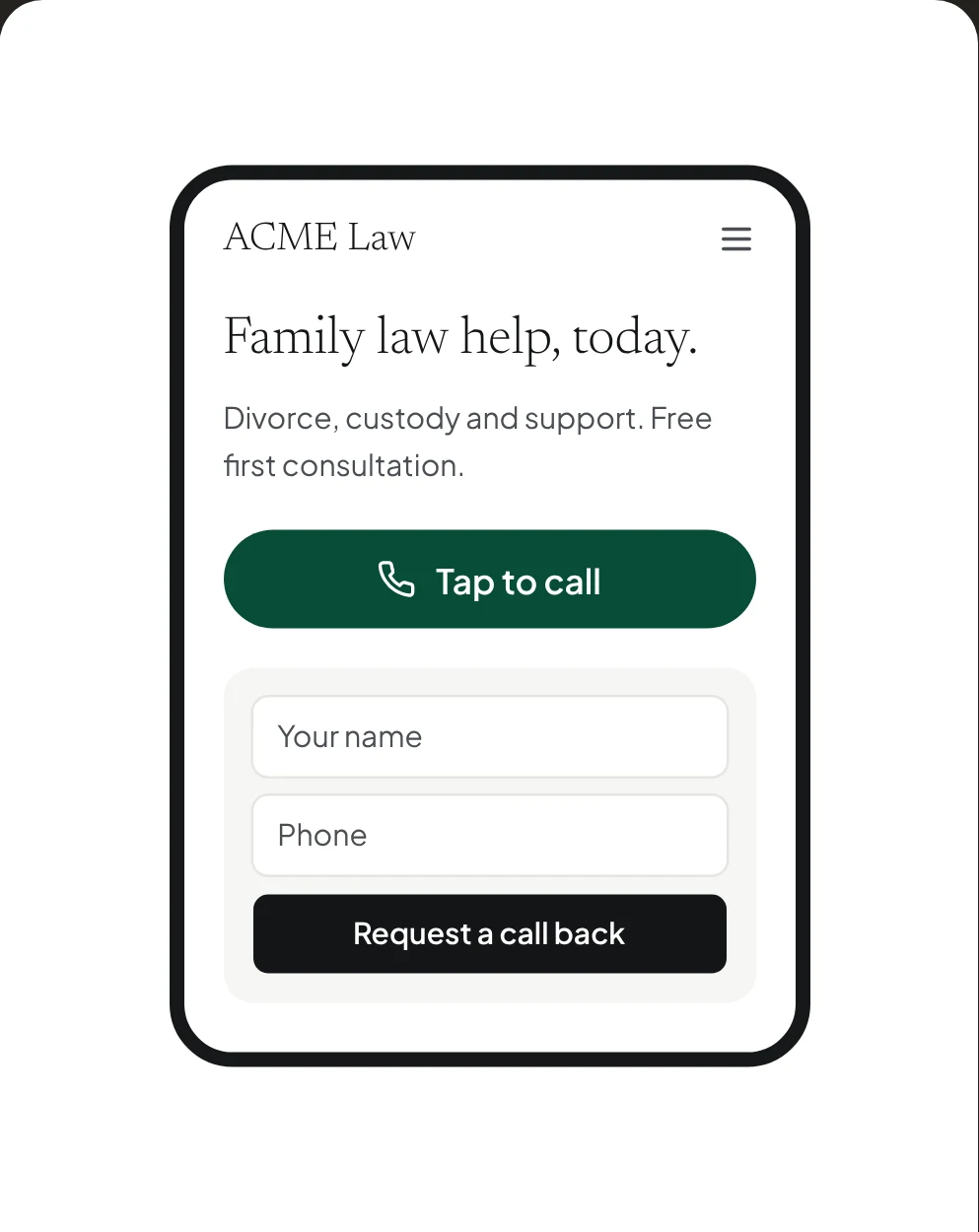
A law firm website has one job: turn the people who find the firm into calls and form fills. That takes a phone number people can tap, short forms, call-back and chat options, a page for every practice area, a site that loads fast and works on a phone, and the trust signals people look for before they call.
Google measures part of this directly. Its Core Web Vitals look at how quickly a page's main content loads, how quickly it responds and how stable it stays, with targets of 2.5 seconds, 200 milliseconds and 0.1. And Google finished moving to mobile-first indexing, so the mobile version of a site is the one it crawls.
How does Lotus Signal handle a law firm website?
The work runs in six steps. The first decides between a fix and a rebuild; the rest apply either way.
1. Start with what's working
The review starts with what the current site already does well, because most law firm sites can be fixed rather than rebuilt.
How this works
Lotus Signal starts with what's working. Most law firms build a website once and never update it, so it ends up looking outdated, with old content. That doesn't always mean starting over: most sites can be fixed.
A rebuild comes in when fixing won't do: when the firm's brand positioning has changed, or the design is too dated to bring up to date. Law firm branding covers the positioning work.
2. Make it easy to call or write
Every page makes it easy to reach the firm: a phone number you can tap, short forms, a call-back option, chat and a way in after hours.
How this works
Whatever helps drive conversions goes in: a phone number that can be tapped on a phone, short forms, a call-back option, chat for people who would rather type than call, and a way to reach the firm after hours. Each one gives a visitor a way to reach the firm without hunting for it.
3. Give every practice area its own page
Each practice area gets its own page, so people who search for a specific problem land on a page about it.
How this works
Each practice area gets its own page, written for the people who need it and linked to the rest of the site. A firm that handles family law and criminal defense needs a page for each, not one page that lists both. The same pages are where Google Search Ads send clicks and what SEO and AI search build on.
4. Make it fast and work on a phone
Speed matters, so the site is built to load quickly and work properly on a phone, the version Google now crawls.
How this works
Speed matters. The targets to aim for are Google's Core Web Vitals: the main content loading within 2.5 seconds, the page responding within 200 milliseconds and the layout staying stable as it loads.
The site also has to work on a phone. Google's page experience guidance asks whether pages display well on mobile devices, are served securely and avoid intrusive pop-ups.
5. Show the trust signals people look for
Reviews, results, attorney bios, bar memberships, real photos and the languages the firm speaks all go where visitors can see them.
How this works
People check a firm before they call. Reviews, results, attorney bios, bar memberships, real photos of the team and the languages the firm speaks all go where visitors can see them. Languages matter most for practice areas like immigration.
Results are shown with care. ABA Model Rule 7.1 bars false or misleading statements about a lawyer's services, and its comments note that past results can mislead if they suggest every client will get the same outcome (ABA, 2026).
6. Keep it updated
Fixes usually take about six weeks and then continue, because a site that is built once and never updated is how firms end up with an outdated one.
How this works
Fixes usually take about six weeks, and then the work is ongoing. A rebuild takes 8 to 12 weeks. Either way, the site isn't built once and left: content, pages and design keep getting updated.
Should a law firm fix its website or rebuild it?
Fix it if it can be fixed. Most law firm websites can be; the rest need a rebuild because the firm's positioning has changed or the design is too dated to bring up to date.
| Fix or rebuild | Typical |
|---|---|
| Law firm websites that can be fixed, in most cases | About 60% |
| Fixing the current site | About 6 weeks |
| After the fix | Ongoing |
| Full rebuild | 8–12 weeks |
| Who owns the site, either way | Your firm |
Lotus Signal starts with what's working and only rebuilds when fixing won't do. Why your law firm website is leaking leads covers the most common leaks.
What is law firm website conversion?
Law firm website conversion is how well a site turns visitors into calls, form fills and chats. It is the reason every page carries a phone number people can tap, short forms and a call-back option, and the reason speed, mobile and trust signals matter.
Call tracking and form tracking show which pages and channels bring in calls, so the monthly review can see what the site produces, not just how many people visit it.
Who owns the website?
Your firm does. The client keeps the website and owns all of it. If the firm stops working with Lotus Signal, the site stays with the firm, the same as its ad accounts and content.
When does a website rebuild make sense, and when doesn't it?
A rebuild takes 8 to 12 weeks and a fix about six, so the starting point is always what the current site can still do.
Fix it when…
The structure is sound and the content is just old: the pages need updating, not replacing.
The firm's positioning hasn't changed, and the design can be brought up to date.
Rebuild it when…
The firm's brand positioning has changed, and the site no longer says what the firm is.
The design is too dated to bring up to date with fixes.
Either way, the website works with the other levers. Google Search Ads send clicks to its practice-area pages and SEO builds on them, so a site that leaks leads wastes both.
What does this look like for a real firm?
Lotus Signal rebuilt the website of the Law Office of Phan Nguyen, an immigration and family law firm in Texas, around conversions: separate practice-area pages, a mobile-first build and trust signals like case results, attorney bio depth and bar credentials. In the attorney's words: "Lotus Signal and Waleed helped me drive 1400% qualified leads and 3X our signed cases per month — we're literally swamped month over month." The site is part of what the firm owns outright: the case study describes a digital asset (website, content library, review base and ranking footprint) that the firm owns regardless of future marketing decisions. The website work ran alongside SEO and paid search, so the lead growth below comes from the combined work.
From the case study:
Law Office of Phan Nguyen · Texas · Immigration & Family Law: 15× increase in qualified monthly leads (5 → 75) · 4× lower customer acquisition cost.
Want to know where your website is losing calls? Get a free marketing audit of your website, Google presence and reviews, or book a call to talk it through.
Frequently asked questions
Fix it if it can be fixed. Most law firm websites can be; the rest need a rebuild because the firm's brand positioning has changed or the design is too dated to bring up to date.
Fixes usually take about six weeks, and then the work is ongoing. A full rebuild takes 8 to 12 weeks.
A phone number people can tap, short forms, call-back and chat options, a way to reach the firm after hours, a page for every practice area, fast load times, a site that works on a phone, and trust signals: reviews, results, attorney bios, bar memberships, real photos and the languages the firm speaks.
Your firm does. The client keeps the website and owns all of it, including if the firm stops working with Lotus Signal.
Google's Core Web Vitals targets are a good guide: the main content loading within 2.5 seconds, the page responding within 200 milliseconds and a layout shift score below 0.1.
Most law firms build a website once and never update it, so the design and the content age together. After a fix, the work is ongoing so the site doesn't drift out of date again.
Yes, with care. Most states base their advertising rules on ABA Model Rule 7.1, which bars false or misleading statements about a lawyer's services; its comments note that past results can mislead if they suggest every client will get the same outcome. Check your own state's rules.
No. Website work is part of the marketing Lotus Signal runs for a firm, alongside ads, content, social, brand and reviews, not a standalone project.
Start with a conversation
A short call to see if this is the right fit.
Not a pitch. Not a demo. A conversation about your firm, where the cases are coming from, and whether there's a real opportunity to build something better. Fit matters more than volume.
A short, focused conversation. No pitch deck. No annual commitment.
Prefer to start in writing? Get a free marketing audit by email.