
Google Search Ads for Law Firms
Lotus Signal runs Google Ads for lawyers: exact-match search campaigns on the searches people make when they are ready to hire, a negative keyword list that keeps the budget off searches that never become cases, a landing page for every practice area, and call tracking. It is one part of the marketing Lotus Signal runs for established firms, for one flat monthly fee. Your ad spend is paid directly to Google from your own account, with no markup.
Where this fits
Google Search Ads are one lever inside Execution. In Strategy we decide how they split budget with Local Services Ads and what they should and shouldn't bid on.
See everything the engagement coversWhat are Google Search Ads for law firms?
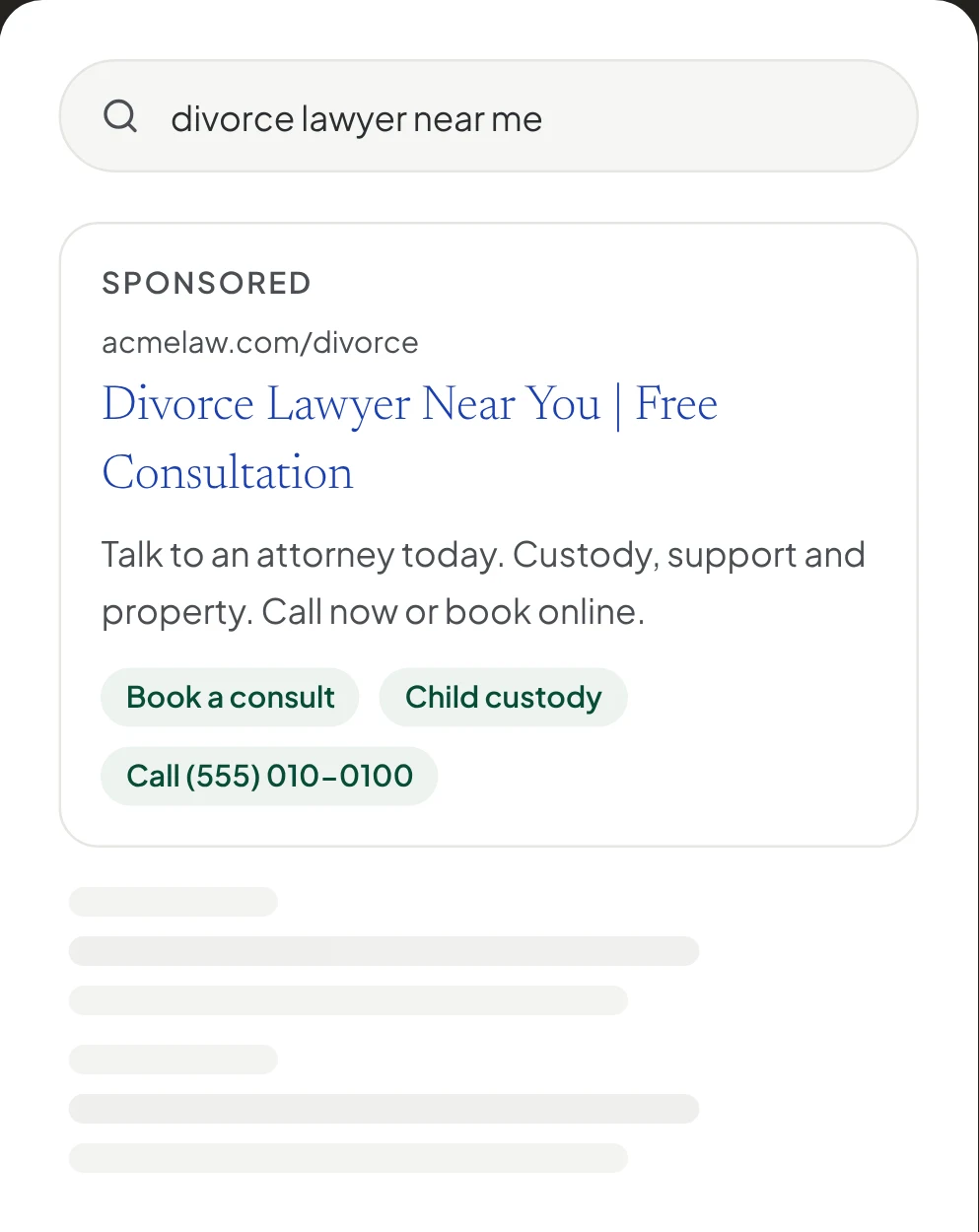
Google Search Ads are the text ads at the top of Google's results for the keywords a firm bids on. The firm pays per click, writes the ads and chooses the page each ad sends people to. They sit below Local Services Ads, which charge per lead instead of per click.
PPC for law firms is the same thing by its industry name: pay-per-click. Whether it works comes down to how tight the account is: which searches it bids on, which it excludes, where the clicks land and whether anyone can tell what kind of calls the ads produce.
How does Lotus Signal run Google Ads for a law firm?
The work runs in six steps. The first four set up the account; the last two keep running while the ads are live.
1. Bid on high-intent searches, on exact match
The ads target the searches people make when they are ready to hire, like "family lawyer [city]" or "car accident lawyer [city]", on exact match.
How this works
The keywords are the searches people make when they are ready to hire a lawyer: "family lawyer [city]", "car accident lawyer [city]" and the equivalent for each practice area the firm handles. They run on exact match, which is the way to go for a law firm.
Broad match is Google's default for new keywords, and it matches searches by meaning, so ads can show for searches that don't contain the keyword's words at all. If you use broad match, you end up bidding on competitor keywords.
2. Keep a negative keyword list
Negative keywords keep the ads off searches that never become cases: "free", "jobs", "pro bono" and practice areas the firm doesn't handle.
How this works
Negative keywords exclude search terms from a campaign. The list starts with the searches that waste money in law firm accounts: "free", "jobs", "pro bono", and practice areas the firm doesn't handle.
3. Bid on the services, not the firm's name
Bidding on the firm's own name isn't as effective; the budget goes on the services the firm actually offers.
How this works
Bidding on the firm's own name isn't as effective as bidding on the actual services. The budget goes on searches for the work the firm does, like a divorce, a DUI or a green card, rather than on people already looking for the firm.
4. Give every practice area its own landing page
Each practice area gets its own landing page, because ads sent to pages that don't match the search are one of the problems audits find most.
How this works
It is essential for each practice area to have its own landing page, built for the searches its ads run on. Someone who searched "car accident lawyer [city]" should land on a page about car accidents in that city, not on the homepage.
Google rates landing page experience on how relevant and useful the page is to people who click the ad. Like the ad account, the pages belong to the firm. Law firm website design covers how those pages are built.
5. Set the schedule on purpose
Running ads at odd hours is one of the problems audits find most, so the schedule is set on purpose instead of left on the default.
How this works
Google Ads campaigns show ads all day by default, and an ad schedule limits them to the days and hours you choose. Running ads at odd hours is one of the problems found most often in law firm accounts, so the schedule is set on purpose, with a budget large enough to keep the ads running across the day and the month.
6. Track every call
Call tracking software shows when calls come in and what type of call each one is, which is where tying spend to signed cases starts.
How this works
Call tracking software shows when calls are coming in and what type of calls they are. Together with what intake records about each lead, it lets the monthly review show what came in, what it cost and what signed.
Google Ads can also take outcomes that happen after a click or a call, like a signed case, back into the account through offline conversion imports.
What does a law firm PPC audit usually find?
Two problems come up most often in law firm Google Ads accounts: ads running at odd hours, and broad match keywords without relevant landing pages. The rest of the table follows from the same rules.
| Problem | Fix |
|---|---|
| Ads running at odd hours | Ad schedule |
| Broad match, which ends up bidding on competitor keywords | Exact match |
| Ads sent to pages that don't match the search | Landing pages |
| Clicks from searches for "free", "jobs", "pro bono" or the wrong practice area | Negatives |
| Budget spent on the firm's own name | Bid on services |
| No way to tell what kind of calls the ads bring in | Call tracking |
The free marketing audit includes your ads: what a client sees when they click, and where the spend may be leaking. It needs no logins or access to your accounts.
How much should a law firm spend on Google Ads?
At least $5,000 a month in ad spend. That is the least a firm should invest to test properly and to keep the ads running across the whole day and the whole month. The ad spend goes to Google from the firm's own account; Lotus Signal's flat monthly fee is separate.
The same floor holds whichever practice areas the firm advertises. How paid search fits next to the other channels for each one is on the practice pages for immigration, family and divorce, criminal defense, estate and probate and personal injury.
How do Google Search Ads and Local Services Ads work together?
There is no universal split. They work as a pair, and depending on the budget, the split can shift. Local Services Ads are the highest-intent channel, so a 70-30 split in their favor is a good starting point. Search Ads add what LSAs can't: exact keyword control, negative keywords and the firm's own landing pages.
For the full comparison, by practice area, by budget and by what each can't do, read Google Ads vs. Local Services Ads for law firms.
When are Google Search Ads the right lever, and when should something else come first?
Search Ads can start bringing in calls within the first several weeks after launch, as long as the budget and the pages behind them are ready.
Search Ads fit when…
The firm can invest at least $5,000 a month in ad spend, enough to test and to keep the ads running across the day and the month.
Each practice area it advertises has its own landing page, and call tracking shows what kind of calls come in.
Something else comes first when…
The budget can't reach that floor yet. Local Services Ads are the highest-intent channel and can carry more of the budget while Search Ads wait.
The website can't turn clicks into calls yet. Ads sent to a site that leaks leads waste the budget, so the pages get fixed first.
Search Ads bring calls sooner; SEO and AI search build over a longer period. In Strategy, Lotus Signal decides how the budget splits between them and the monthly review checks that split.
What does this look like for a real firm?
Frankfurt Law, a family law and criminal defense firm in Dallas, came to Lotus Signal from a long-term contract with a national agency that wasn't producing qualified leads it could trace. Before any money was spent, the existing campaigns were reviewed to find where the budget was burning. Paid search was then rebuilt around tight exact-match Google Ads campaigns, separate funnels for family law and criminal defense, an independent landing page for each practice area, and call tracking. Local SEO ran alongside it, so the results below, within 12 months, come from the combined work.
From the case study:
Frankfurt Law Office · Dallas, TX · Family Law & Criminal Defense: 300% increase in qualified online leads · 4× decrease in wasted marketing spend.
Want to know where your Google Ads spend may be leaking? Get a free marketing audit of your website, Google presence, reviews and ads, or book a call to talk it through.
Frequently asked questions
At least $5,000 a month in ad spend. That is the least a firm should invest to test properly and to keep the ads running across the whole day and the whole month. The spend is paid to Google from the firm's own account.
High-intent searches made by people ready to hire, like "family lawyer [city]" or "car accident lawyer [city]", on exact match. Bidding on the firm's own name isn't as effective as bidding on the services it offers.
Exact match is the way to go. Broad match is Google's default and matches searches by meaning, and if you use it, you end up bidding on competitor keywords.
Start with the searches that never become cases: "free", "jobs", "pro bono" and practice areas the firm doesn't handle.
Yes. It is essential for each practice area to have its own landing page. Broad match keywords sent to pages that don't match the search are one of the most common problems in law firm accounts.
Call tracking software shows when calls are coming in and what type of calls they are. Together with what intake records about each lead, it lets the monthly review show what came in, what it cost and what signed. Google Ads can also import offline outcomes, like a signed case, back into the account.
Usually both, and there is no universal split: depending on the budget, it can shift. Local Services Ads are the highest-intent channel, so a 70-30 split in their favor is a good starting point. Search Ads add exact keyword control, negative keywords and the firm's own landing pages.
The two problems found most often are ads running at odd hours and broad match keywords without relevant landing pages. The free marketing audit includes your ads: what a client sees when they click, and where the spend may be leaking.
Start with a conversation
A short call to see if this is the right fit.
Not a pitch. Not a demo. A conversation about your firm, where the cases are coming from, and whether there's a real opportunity to build something better. Fit matters more than volume.
A short, focused conversation. No pitch deck. No annual commitment.
Prefer to start in writing? Get a free marketing audit by email.